|
|
|
Robert
|
 |
« Reply #1 on: January 10, 2026, 06:38:21 AM » |
|
Cant see the video John because don't do Facebook but a short write on the how the US went off gold to oil. We already have more oil reserves than Saudi Arabia yet it was never told the public, Why? https://www.sandstoneam.com/insights/rise-of-the-petrodollarRise of the petro dollar. THE U.S. DOLLAR'S ROLE AS THE WORLD'S RESERVE CURRENCY WAS FIRST ESTABLISHED IN 1944 WITH THE BRETTON WOODS AGREEMENT. |
|
|
|
|
 Logged
|
“Some people see things that are and ask, Why? Some people dream of things that never were and ask, Why not? Some people have to go to work and don’t have time for all that.”
|
|
|
|
RP#62
|
|
« Reply #2 on: January 10, 2026, 08:26:43 AM » |
|
Robert, I don't do Facebook either but when you click on the link and that log on block comes up, if you hit the "X" in the upper right corner to cancel out, the log on block goes away and you can see the video.
RP
|
|
|
|
|
Logged
|
|
|
|
|
sandy
|
|
« Reply #3 on: January 10, 2026, 08:44:17 AM » |
|
After Japan attacked China in 1937, the US wanted to hurt Japan by restricting their ability to wage war. We began restricting resources to Japan. After nearly 4 years of sanctions, Pearle Harbor was attacked. If we restrict Chinas oil imports, how long would retaliation take?
People who forget history tend to repeat it.
|
|
|
|
|
Logged
|
|
|
|
|
TJ
|
|
« Reply #4 on: January 10, 2026, 09:01:13 AM » |
|
|
|
|
|
|
Logged
|
|
|
|
|
old2soon
|
|
« Reply #5 on: January 10, 2026, 09:13:30 AM » |
|
ANYONE restricting what 60 70% of chinas energy NEEDS just might be yankin the tigers tail. And WHEN not IF but WHEN china retaliates because of the curtailed energy supplies thinkin xi will do way more than just rattle sabers. And YESi PRAY Fervently i'm WRONG! RIDE SAFE.
|
|
|
|
|
Logged
|
Today is the tommorow you worried about yesterday. If at first you don't succeed screw it-save it for nite check. 1964 1968 U S Navy. Two cruises off Nam.
VRCCDS0240 2012 GL1800 Gold Wing Motor Trike conversion
|
|
|
|
Jersey mike
|
|
« Reply #6 on: January 11, 2026, 04:36:58 AM » |
|
|
|
|
|
|
Logged
|
|
|
|
|
F6Dave
|
|
« Reply #7 on: January 11, 2026, 02:47:42 PM » |
|
Like so many things, I'm sure there were multiple reasons for the 'Maduro Mission'. Oil had to be at the top of the list, but interrupting the drug trade was surely a factor. Trump had been telegraphing that for months. And while they avoid the term 'regime change', having a friendlier government in the region had to be a plus. There could also be a domino effect in Cuba.
It looked like a huge advertisement for America's military. The mission's flawless precision, with weapons and tech never seen before, surely impressed (and concerned) America's adversaries. That had to be intentional.
I don't know how much this will affect China's energy supply. Venezuela only produces 1 million barrels of oil per day, a third of their peak 20 years ago, before Hugo Chavez confiscated American assets and ran the industry into the ground. According to that FB video China takes 70% of Venezuela's 1 million, but they consume over 16 million BOPD. So China gets 4% of their oil from Venezuela. That should be easy to replace.
In fact that's what usually happens. After invading Ukraine it was widely predicted that Russia would be economically devasted by losing the European oil and gas market. But what actually happened is the trade routes changed. Russia sold more to Asia, while the Middle East shipped more to Europe and less to Asia. Exports of LNG from the US to Europe skyrocketed to replace Russian natural gas.
As for Venezuela's oil, it will be a huge and expensive task to restore their infrastructure. I've read that facilities are crumbling. Tanks and flowlines are rusted and leaking, and refineries operate at 20% of capacity, being used largely for storage. Their heavy oil is notoriously difficult to produce and refine. I think steam flooding is used in one of their fields, which entails injecting steam into adjacent wells to liquify the oil enough to flow. When I worked for Chevron we used the technique for the very heavy oil (solid at room temperature) produced by the Kern River field in California. American oil companies have been burned in Venezuela before. I'm sure they're approaching this cautiously.
|
|
|
|
|
Logged
|
|
|
|
|
F6Dave
|
|
« Reply #8 on: January 12, 2026, 05:56:12 AM » |
|
I just read that Exxon is backing away from Venezuela. Unless a stable and friendly government emerges, I doubt that many companies will want to invest the massive capital needed after 20 years of Communist 'management'.
|
|
|
|
|
Logged
|
|
|
|
|
Jersey mike
|
|
« Reply #9 on: January 13, 2026, 03:57:44 AM » |
|
I think companies will eventually get back in the region after some tip toeing around.
I don’t know who has been to the sites to really say exactly what the issues are or if the heads of the industry are just speculating on how the equipment is really functioning and to what degree of degradation the sites are really in.
There’s not a lot of info on who has actually stepped foot into the area to get a first hand look at what needs what.
If a production mark of say 1.5M barrels a day can be achieved (I think they can produce 800k now) that would be a good start.
Their reserves are supposed to be over 300B barrels (reserves are what they actually know is available with some pretty good certainty) so the oil is there, it’s just a matter of getting it out and to the market.
|
|
|
|
« Last Edit: January 13, 2026, 04:02:41 AM by Jersey mike »
|
Logged
|
|
|
|
|
HayHauler
|
|
« Reply #10 on: January 13, 2026, 05:08:36 AM » |
|
I think companies will eventually get back in the region after some tip toeing around.
I don’t know who has been to the sites to really say exactly what the issues are or if the heads of the industry are just speculating on how the equipment is really functioning and to what degree of degradation the sites are really in.
There’s not a lot of info on who has actually stepped foot into the area to get a first hand look at what needs what.
If a production mark of say 1.5M barrels a day can be achieved (I think they can produce 800k now) that would be a good start.
Their reserves are supposed to be over 300B barrels (reserves are what they actually know is available with some pretty good certainty) so the oil is there, it’s just a matter of getting it out and to the market.
From what I have read, their crude is very hard to refine. They need some petroleum "thinners" to be added to it just to refine it, so the cost is higher. But, 300B barrels is a sizeable reserve. Hay  Jimmyt |
|
|
|
|
Logged
|
|
|
|
|
F6Dave
|
|
« Reply #11 on: January 13, 2026, 06:54:17 AM » |
|
I think companies will eventually get back in the region after some tip toeing around.
I don’t know who has been to the sites to really say exactly what the issues are or if the heads of the industry are just speculating on how the equipment is really functioning and to what degree of degradation the sites are really in.
There’s not a lot of info on who has actually stepped foot into the area to get a first hand look at what needs what.
If a production mark of say 1.5M barrels a day can be achieved (I think they can produce 800k now) that would be a good start.
Their reserves are supposed to be over 300B barrels (reserves are what they actually know is available with some pretty good certainty) so the oil is there, it’s just a matter of getting it out and to the market.
Chevron operates about 5 fields in Venezuela, both onshore and offshore. They're also non-operating partners in several others. So Chevron employees and contractors (who service other fields operated by Venezuelans) have surely visited facilities all around the country. While I'm sure Chevron's facilities have received better maintenance, there are widespread, detailed reports of the crumbling infrastructure. Two decades of little to no maintenance along with parts scavenging takes a heavy toll. |
|
|
|
|
Logged
|
|
|
|
|
F6Dave
|
|
« Reply #12 on: January 13, 2026, 06:57:21 AM » |
|
From what I have read, their crude is very hard to refine. They need some petroleum "thinners" to be added to it just to refine it, so the cost is higher. But, 300B barrels is a sizeable reserve. Hay Jimmyt There's another downside to that heavy crude. Because it's more expensive to refine, it's discounted by $5 to $10 per barrel. With oil prices hovering around $60, that discount makes investment in Venezuela less attractive. |
|
|
|
|
Logged
|
|
|
|
|
Jersey mike
|
|
« Reply #13 on: January 13, 2026, 04:06:07 PM » |
|
I think companies will eventually get back in the region after some tip toeing around.
I don’t know who has been to the sites to really say exactly what the issues are or if the heads of the industry are just speculating on how the equipment is really functioning and to what degree of degradation the sites are really in.
There’s not a lot of info on who has actually stepped foot into the area to get a first hand look at what needs what.
If a production mark of say 1.5M barrels a day can be achieved (I think they can produce 800k now) that would be a good start.
Their reserves are supposed to be over 300B barrels (reserves are what they actually know is available with some pretty good certainty) so the oil is there, it’s just a matter of getting it out and to the market.
Chevron operates about 5 fields in Venezuela, both onshore and offshore. They're also non-operating partners in several others. So Chevron employees and contractors (who service other fields operated by Venezuelans) have surely visited facilities all around the country. While I'm sure Chevron's facilities have received better maintenance, there are widespread, detailed reports of the crumbling infrastructure. Two decades of little to no maintenance along with parts scavenging takes a heavy toll. I thought Chevron was also out completely but basically their signs were still up and those who are running the all the facilities are basically employees of Venezuela. There was also talk of that’s why the Chinese were getting their foot in the door down there. |
|
|
|
|
Logged
|
|
|
|
|
F6Dave
|
|
« Reply #14 on: January 16, 2026, 07:21:22 AM » |
|
I thought Chevron was also out completely but basically their signs were still up and those who are running the all the facilities are basically employees of Venezuela. There was also talk of that’s why the Chinese were getting their foot in the door down there.
I worked for Texaco (pre-merger) and Chevron for 20+ years, but it was all in the USA. However many of my friends worked overseas, and my son has worked all over the world as an engineer for Scientific Drilling Intl. From what I've heard the overseas offices are mostly staffed by locals who are employed by the company. There are probably lots of contractors (Halliburton, Schlumberger, etc.), especially at drilling sites where typically they perform nearly all of the work, which is also the case in the USA. I'm probably getting into the weeds too much here, but there's a big difference between operated and non-operated wells. The operator usually holds a majority of the mineral rights and is directly responsible for all operations. Non-operating partners own a smaller fraction of the mineral rights and receive their share of the revenue, but also get billed for their share of the expenditures. They have access to detailed engineering and expense data but don't make the day-to-day decisions. Finally there are the royalty owners, who get a percentage of the revenue but aren't billed for expenses. Here in the USA either private landowners or the government owns the royalty rights. Elsewhere it's usually the government. The USA is nearly alone in allowing individuals to own mineral rights. Thankfully our founders understood the importance of property rights. Now I'll (finally) get to my point: since Chevron is the operator of ~5 fields in Venezuela, they likely have plenty of firsthand knowledge about the condition of the oil and gas infrastructure there. Their website has a page dedicated to it: https://www.chevron.com/worldwide/venezuela |
|
|
|
|
Logged
|
|
|
|
|
Pluggy
|
|
« Reply #15 on: January 16, 2026, 10:13:11 AM » |
|
Dave, were you working in 2014? My employer made undersea oil well equipment. In January 2014, oil was above $100 and everybody was drilling. By December, the price had fallen to around $50 and most exploring and drilling stopped. There was little demand for our product and the result was a big layoff.
At the present prices, do you think companies will invest in more capacity?
|
|
|
|
|
Logged
|
|
|
|
|
F6Dave
|
|
« Reply #16 on: January 16, 2026, 12:00:04 PM » |
|
Dave, were you working in 2014? My employer made undersea oil well equipment. In January 2014, oil was above $100 and everybody was drilling. By December, the price had fallen to around $50 and most exploring and drilling stopped. There was little demand for our product and the result was a big layoff.
At the present prices, do you think companies will invest in more capacity?
Yes I was working in 2014, though not for Chevron. I took early retirement after the merger rather than move to Houston, and started doing contract work. I love what I do, so last year I went from mostly retired to mostly working on a 6 month project helping a company with well data in Utah. I remember 2014 well. My son had just graduated from the Colorado School of Mines and had his first job. When the prices collapsed he watched as many of his co-workers were laid off. I watched that many times at Texaco and it's no fun. Luckily he was a new hire with a pretty low salary and survived the cuts. I've never been able to predict the future in this industry. Too many unpredictable events shape the market. 20 years ago nobody dreamed that US production would stop declining and more than double thanks to the shale revolution. Terminals in Texas and Louisiana that were built to import LNG from the middle east were converted to export terminals after we figured out how to get gas from shale. Then due to Europe replacing Russian gas with our LNG, we're now the biggest exporter in the world. All I can say is that better technology has brought the break even price down. Companies are now making money with oil under $60, which wasn't possible a few years ago. Of course location makes a big difference. A profitable well in Texas may be a loser in California. I've never worked on offshore production so I don't know much about those economics. I know those platforms costs zillions, but they can produce staggering amounts of oil. When my son was working in the North Sea he told me about 30" and 36" conductor casing, many times larger than anything I ever dealt with. They must flow a lot of oil! |
|
|
|
|
Logged
|
|
|
|
|
Jersey mike
|
|
« Reply #17 on: January 16, 2026, 12:13:01 PM » |
|
I thought Chevron was also out completely but basically their signs were still up and those who are running the all the facilities are basically employees of Venezuela. There was also talk of that’s why the Chinese were getting their foot in the door down there.
I worked for Texaco (pre-merger) and Chevron for 20+ years, but it was all in the USA. However many of my friends worked overseas, and my son has worked all over the world as an engineer for Scientific Drilling Intl. From what I've heard the overseas offices are mostly staffed by locals who are employed by the company. There are probably lots of contractors (Halliburton, Schlumberger, etc.), especially at drilling sites where typically they perform nearly all of the work, which is also the case in the USA. I'm probably getting into the weeds too much here, but there's a big difference between operated and non-operated wells. The operator usually holds a majority of the mineral rights and is directly responsible for all operations. Non-operating partners own a smaller fraction of the mineral rights and receive their share of the revenue, but also get billed for their share of the expenditures. They have access to detailed engineering and expense data but don't make the day-to-day decisions. Finally there are the royalty owners, who get a percentage of the revenue but aren't billed for expenses. Here in the USA either private landowners or the government owns the royalty rights. Elsewhere it's usually the government. The USA is nearly alone in allowing individuals to own mineral rights. Thankfully our founders understood the importance of property rights. Now I'll (finally) get to my point: since Chevron is the operator of ~5 fields in Venezuela, they likely have plenty of firsthand knowledge about the condition of the oil and gas infrastructure there. Their website has a page dedicated to it: https://www.chevron.com/worldwide/venezuelaThanks for the info  |
|
|
|
|
Logged
|
|
|
|
|
|
|
F6Dave
|
|
« Reply #19 on: April 10, 2026, 06:35:59 AM » |
|
It's good to see some production returning. I suspect Chevron maintained their facilities better than the government (probably none at all). That could help replace part of the oil that's not getting through the straits. Some Saudi oil may still be flowing since they have a pipeline to the Red Sea. Luckily most US oil imports come from Canada, Mexico, and other non-OPEC countries. Which is why we're not seeing shortages like Europe (especially the UK) and Asia. Here's the import split: 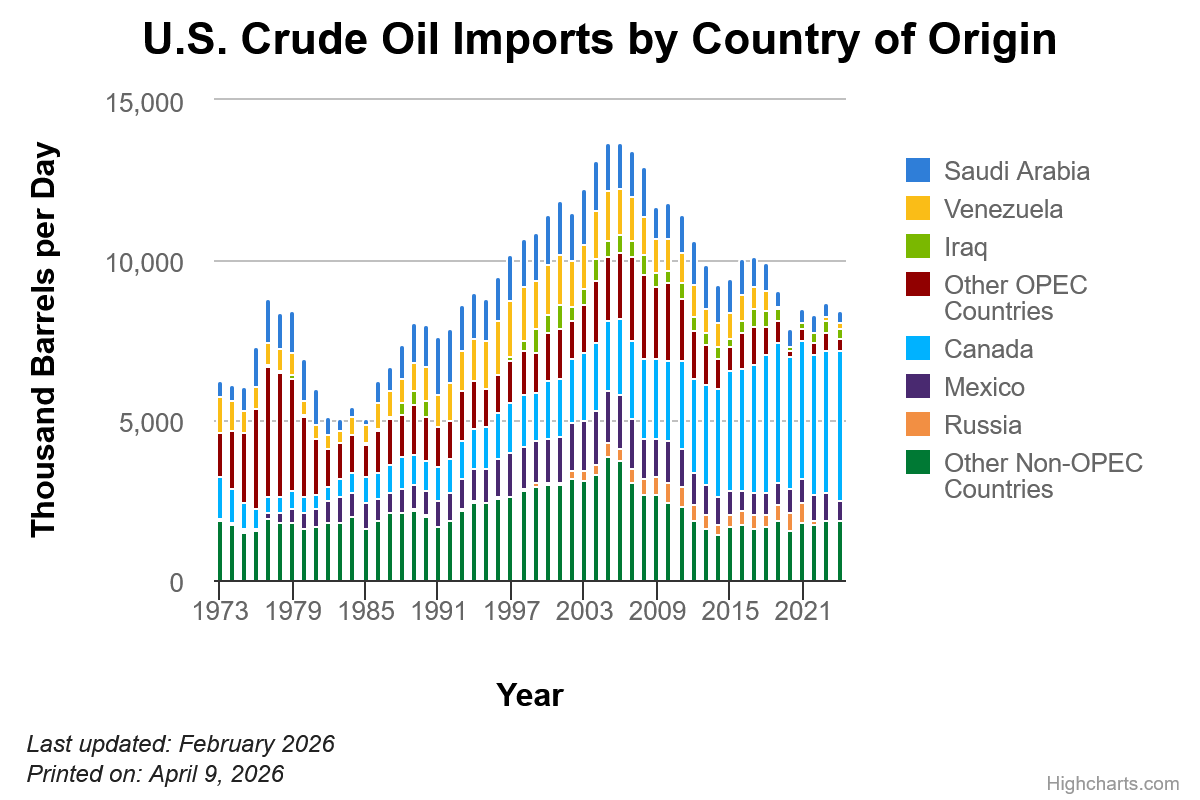 |
|
|
|
|
Logged
|
|
|
|
|
Jersey mike
|
|
« Reply #20 on: April 11, 2026, 04:44:38 AM » |
|
I know “oil” is a huge global commodity and there are a 3-4 (there’s Brent crude, Texas, Dubai and another I think) primary oil commodities that basically drive the current prices/market.
I wonder now if new one could open up that would favor the western hemisphere.
I realize that would be counterproductive to how lots of investors make big money on the cost of oil but if we are producing oil here and Canada is producing oil and Mexico is producing oil and Venezuela is now producing oil again let that market be represented on the global market as Dubai basically represents the Middle East oil producers. Could it drive market prices down, possibly but I think it could be an option for investors to put money where it could change the prices of the others.
|
|
|
|
|
Logged
|
|
|
|
|
Hook#3287
|
|
« Reply #21 on: April 11, 2026, 06:25:44 AM » |
|
The chart F6Dave provided is somewhat eye opening.
Our total imports are at near same levels as in the 80's.
Wonder how those totals compare to total barrels used?
Best numbers I could find quick are during the years 1980-1989 us consumed approximately 15.75 -16 million barrels daily on average.
Numbers I found for the most recent figures are around 20 mil barrels daily.
So rough figures are around 25-33 % increase.
Guess that means we are absolutely increasing domestic production.
|
|
|
|
« Last Edit: April 11, 2026, 06:41:35 AM by Hook#3287 »
|
Logged
|
|
|
|
|
F6Dave
|
|
« Reply #22 on: April 11, 2026, 07:06:43 AM » |
|
Guess that means we are absolutely increasing domestic production.
US oil production has definitely increased. It bottomed out in 2008 at just under 5 million barrels per day. But that was at the very beginning of the 'shale revolution', where we were learning how to use horizontal drilling and hydraulic fracturing to release massive amount of oil and gas from 'tight' shale formations. That technology has nearly tripled US production to about 13.6 million BOPD! Just as amazing is that nearly half of that production (6 million BOPD) comes from a single location: the Permian Basin in West Texas and SE New Mexico. It's the reason NM is now the second largest oil producing state. If the Permain Basin were a nation, they'd be the 4th largest oil producer in the world. I was working for a small oil company in 2008, the dawn of the shale revolution. They were drilling their first ever horizontal wells. It was almost comical (and very expensive) as they took months to drill wells than now take a week or so. One took almost 7 months! I remember the drilling engineer saying how this would never work and we should go back to drilling vertical wells. |
|
|
|
|
Logged
|
|
|
|
|
F6Dave
|
|
« Reply #23 on: April 11, 2026, 07:36:52 AM » |
|
I know “oil” is a huge global commodity and there are a 3-4 (there’s Brent crude, Texas, Dubai and another I think) primary oil commodities that basically drive the current prices/market.
I wonder now if new one could open up that would favor the western hemisphere.
I realize that would be counterproductive to how lots of investors make big money on the cost of oil but if we are producing oil here and Canada is producing oil and Mexico is producing oil and Venezuela is now producing oil again let that market be represented on the global market as Dubai basically represents the Middle East oil producers. Could it drive market prices down, possibly but I think it could be an option for investors to put money where it could change the prices of the others.
There are dozens of crude oil price indexes around the world. The prices vary widely, currently from about $80 per barrel to over $120. While West Texas Intermediate is currently at $96.57, Western Canadian Select is at $85.52. That's because of the remote location and the fact that much of Western Canada (like the tar sands) produces heavy, sour (High H2S) oil that is more difficult to refine. Natural gas varies even more, because it's priced regionally due to the difficulty of transporting the stuff. Here is the US we pay $2.65 per million BTU (MMBTU), while in Europe they're paying $15.84, because it has to be refrigerated and liquified to get there. Asia is paying $19.50. Natural gas is an incredible bargain here. A barrel of oil has 6 MMBTU, so $15.90 worth of natural gas has the same energy content as a $95 barrel of oil. |
|
|
|
|
Logged
|
|
|
|
|
Hook#3287
|
|
« Reply #24 on: April 12, 2026, 07:04:44 AM » |
|
Interesting info guys Natural gas seems like a good alternative to drilling, transporting and refining crude oil. And yet, the communist governor, when first elected in my state, proudly exclaimed to have shut down a pipe line to provide it. You know, cause wind and solar are working out so well. |
|
|
|
|
Logged
|
|
|
|
|
F6Dave
|
|
« Reply #25 on: April 12, 2026, 12:11:34 PM » |
|
Compressed Natural Gas (CNG) often makes sense as a vehicle fuel, especially for fleets with central fueling locations. I've read that Waste Management and UPS have CNG fueled trucks. In some regions you can even buy it at gas stations. Here's a Love's in Oklahoma selling it. 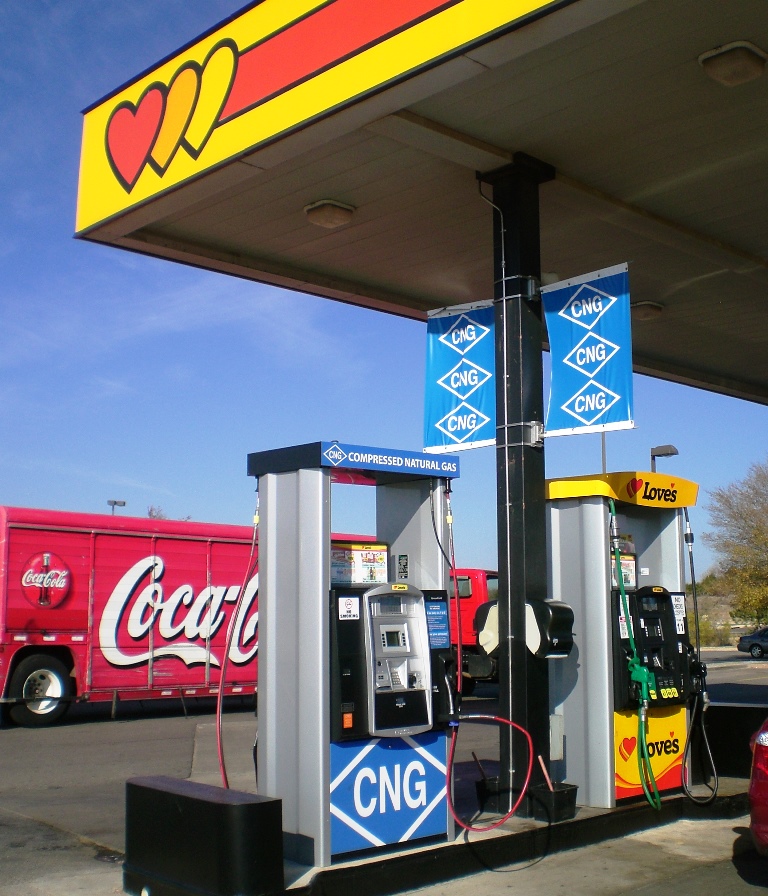 |
|
|
|
|
Logged
|
|
|
|
|
F6Dave
|
|
« Reply #26 on: April 12, 2026, 12:26:35 PM » |
|
Like oil, US natural gas production has more than doubled since the shale revolution began. But while oil can be transported from a well by truck, natural gas needs a pipeline. And since most oil wells also produce associated natural gas, that's a problem in areas far from a pipeline. The only solution is to flare it, which is visible when travelling in parts of Western North Dakota or the Permian Basin at night.
In the Permian Basin natural gas pipeline construction hasn't kept up with all the drilling, so they are running at capacity. As a result the price of natural gas is often negative, especially this time of year with the heating season ending. It looks like right now oil producers are paying over $4 per MMBTU for pipelines to take their natural gas. With $95 oil they're still making plenty of money, but that's not always the case when prices drop below $60.
There's also some flaring PA and WV. That might not be the case if the folks in New England would allow a few new pipelines.
|
|
|
|
|
Logged
|
|
|
|
|